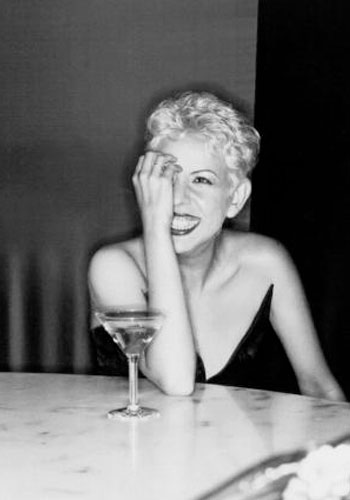
Tinisima
By Elena Poniatowska

Tinisima is many books in one: a voluminous novel about the notorious Italian photographer and activist Tina Modotti (1896-1942); a travelogue; a photo album; an annotated collection of Modotti's correspondence; and a catalogue of the innumerable personalities she came across during her stints as a Communist in France, Spain, the Soviet Union and the Americas both north and south of the Rio Grande. That Elena Poniatowska, Mexico's foremost femme de lettres, almost succeeds in annealing these elements into a smoothly tempered whole is testament to her huge talent as a fiction writer and amateur historian.

Poniatowska's objective is not to scrutinize Modotti's heavy-handed Stalinism or correct center-right intellectuals like Octavio Paz, who have all but dismissed her photographic legacy. The novelist,is after something altogether different: apprehending the inner life of a suffering woman obsessed with rebellion, both on the street and in the privacy of her bed. Modotti wasn't a prolific photographer, and neither was she a very original one. Her images, compared with those of Lola and Manuel Alvarez Bravo, the foremost Mexican photographers of her era, or with those of her teacher and lover Edward Weston, are tame and superficial. But they are unsettling: Modotti thrived in exploring the status quo and used her lens to express anger at the social iniquity she witnessed. She became a cause caliber and today is ranked alongside Henri Cartier-Bresson, Eliot Porter, Paul Strand and Festoon as among the most imaginative foreigners ever to photograph Mexico. She might not have been the most genuine of artists, but her exclusiveness paid off.

This only partly explains why Poniatowska and other contemporary Mexican intellectuals are fascinated by Modotti. Since the early eighties, she has been the subject of a spate of essays, retrospectives, plays, films and television documentaries in Mexico. Her status is now not unlike that of Frida Kahlo--a kind of south-of-the border equivalent of Camille Claudel. Both Kahlo and Modotti have been turned into postmodern heroines who belong to les annees folles, the romantic period that extended from the twenties to World War II and served as a stage on which female idealists sacrificed everything--their bodies, their souls, their talents--to endorse macho causes. They were women who loved their men too much (Weston, Diego Rivera, Auguste Rodin) and ended up paying a heavy price; they also perceived themselves as the eclipsed half of the  relationship, even when they were both sun and moon to their male lovers.

The difference between Kahlo and Modotti, of course, is that Kahlo made an art of exhibiting her own suffering. Modotti's photographs are only occasionally autobiographical, and she rarely turned the camera on herself. Furthermore, Modotti's art seems secondary to her political odyssey, in which she was used) abused and even turned into a scapegoat by friends, government and press. Modotti has all the attributes of martyrdom and martyrs, after all, embody a sense of sacrifice and loss. In this respect, the recent renaissance can be seen as the nostalgia of contemporary Mexican intellectuals for a time when the intelligent urban left truly mattered. Poniatowska starts with Modotti's most scandalous year, 1929. Julio Antonio Mella, her lover, an exiled Cuban activist, is assassinated on the streets of Mexico's capital, and as he lies dying on the pavement he accuses the dictator Gerardo Machado of plotting his end. It is an unstable epoque for the nation and a dangerous season for foreign militants. Armed insurrections have taken place not long beforehand and Alvaro Obregon, running for a second chance as president, has been killed by a fanatic; as a war is openly declared against Communists, seen as traitors and anti-nationalists, the Partido Nacional  Revolucionario, the forerunner of today's ruling Partido Revolucionario Institucional, is founded.

In this atmosphere, Modotti, well-known for her licentious sexuality and for her radical politics, is accused of complicity in Mella's death. The Mexican press, in articulate the powerful daily Excelsior, makes her case look like a preview to O.J. Simpson's: Excerpts from police interrogations are published regularly, as are photographs real and concocted, interviews true and imagined, and other forms of yellow journalism. Modotti is quickly turned into a symbol. As loyalists counterattack the government-sponsored campaign against her, she takes refuge in Tehuantepec, but soon after, in 1930, is publicly accused yet again, this time of plotting against the newly elected president, Pascual Ortiz Rubio. She is convicted' and after a brief stint in prison is asked to leave the country immediately. Thus ends Modotti's most artistically productive and politically vociferous period.
Thus, also, begin the most enthralling sections of Tinisima.

About a third of the book is set in Europe and the Soviet Union, where Modotti lived after her departure from Mexico. Poniatowska plaits in her early life as well, from her period as an actress in Hollywood (in 1920 she was cast in The Tiger's Coat, directed by Roy Clements) to her affair with Weston, in whose studio she studied in Los Angeles. After a lack of commitment on both parts, the couple moved together to Mexico City, settling in 42 Veracruz Avenue, on the corner of Tampico, a house-turned- shrine where, as I write, an enlargement of Weston's famous 1924 photograph of Modotti's bare-breasted torso hangs to commemorate the hundredth anniversary of her birth. The paths of her story, though lies in her late Mexican days, as she shakes hands with luminaries who changed the nation and the world. Although Poniatowska doesn't waste energy injecting this section with a unique narrative cadence, to readers interested in the crossroads of art and ideology in the Hispanic orbit, and particularly the Muralist era in Mexico, this portion of the novel is stellar.

Poniatowska's research is estimable: Modotti's liaison with the Mexican Communist Party and her collaborations in its organ, El Machete; her friendship and subsequent confrontations with Jose Clemente Orozco, Rivera and Kahlo; her multiple and multifaceted lovers, native and foreign; and her links to other left-wing Latin Americans and to Marxist groups in France, Germany, Italy and Spain are littered with cameo appearances of all sorts, proving that Mexico between wars was the ultimate meeting ground of dreamers. At one point D. H. Lawrence passes by, and so do Jean Charlot, Augusto Cesar Sandino, Vladimir Mayakovsky, B. Traven, Sergei Eisenstein and the Peruvian Jose Carlos Mariategui. This parade ends with Pablo Neruda's eulogy to Modotti, the first stanza of which reads:

Tina Modotti, sister, you do not sleep, no,
you do not sleep.
Perhaps your heart hears the rose of
yesterday
growing, the last rose of yesterday, the
new rose.
Rest gently, sister.

If the abundance of references seems often overwhelming (novel and index usually preclude each other, but I vote in favor of attaching one to the paperback of Tinisima), it hints at the method by which Poniatowska composed her book: Highly regarded in what has come to be known as literatura testimonial, a genre perfectly suited to the Hispanic reality in that it gives voice to the voiceless, she is responsible for the classic Massacre in Mexico, a pastiche of news clippings, poems, photographs, transcriptions of interviews and other paraphernalia about the 1968 government-sponsored slaughter of hundreds of students in the Plaza de las Tres Culturas, in Tlatelolco Square, Mexico City. The
technique of cut-and-paste is also apparent in her prolific journalism, published in the newspaper La Jornada, as well as in her miscellaneous book of anecdotes and news reports on the 1985 earthquake in Mexico's capital. Poniatowska's fiction is almost always historical, its characters drawn to resemble closely their real-life counterparts (as in Dear Diego, an epistolary fiction about Angelina Beloff Diego Rivera's first wife). Facts are presented as such Poniatowska's interest lies not in blurring genre distinctions but in using the novel as a means through which to rehumanize our view of legendary characters and explore their vulnerabilities. Her most remarkable work of fiction has not appeared in English translation. Titled "Hasta no verse, Jesus mio", it is an exploration of early twentieth-century Mexico from the eyes of a stolid lower-class woman of admirable character a counterpoint toTinisima in that the two visit the same period from opposite ends of the social spectrum.

Modotti's letters, her photographs which open most chapters, the frequent quotes on top of quotes, the news report, -these make for a demanding revisionist read. If Poniatowska can be a master of polyphonic documentaries that are funny and moving, she can also be wordy and repetitious, and this book showcases both extremes: The plot is poignant  and its presentation insightful but also challenging in its redundancies. Given Poniatowska's proclivity to overemphasize, to accumulate data, to turn narrative into archive, however, the good news is that the English translation by Katherine Silver may be seen as something of an expurgation. After all, the 1992 Spanish original ran to 663 pages. Something was gained in translation: The basic plot remains but unfolds with fewer obstacles.

The novel is a welcome addition to what is already becoming a trend: volumes of fiction and nonfiction from Mexico attempting to limn the labyrinthine paths of the nation's ever-disoriented left. The results are mixed: Some, like the thrillers of Paco Ignacio Taibo II,
particularly those with his private eye Hector Belascoaran Shayne as protagonist, are at once parodic and consciously derivative; others, such as The Mexican Shock by Jorge Castaneda, or A New Time for Mexico, by Carlos Fuentes, are impressionistic studies, some more personal, others more scholarly, attempting to understand the present challenge and intellectual roots of figures like Cuauhtemoc Gardenas and Subcomandante Marcos. Poniatowska's Tinisima stands alone among them: It focuses on the most daunting period of Mexican left-wing utopianism, is ambitious in scope and places full attention, for a change, on the feminine. The picture of Tina Modotti that emerges is that of a romantic profeminist misunderstood and abhorred by the macho society around her, a woman whose camera mattered far less--to her and her contemporaries-- than her tragic fall from grace. It is a telling picture, one that says much about Mexico's turbulent past, and about its nostalgic present.


The Nation, October 28 1,996. By ILAN STAVANS