|
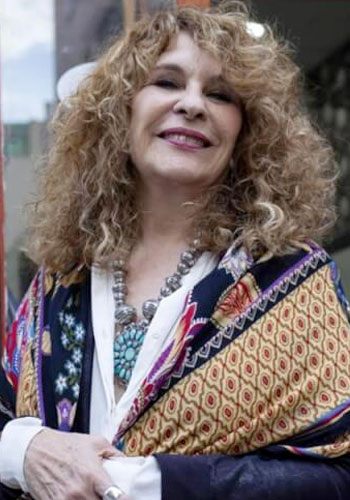
Gioconda Belli
Bio
A powerful dream
lead been revealed about the early years of Belli's life. Only one
thing is certain: that by the year 1970 her poems were appearing
in several Latin American publications: El Gallo Ilustrado, La Prensa
Literaria and Nicaracuac, among others. No one doubted then the
vibrant strength of her voice, and this was corroborated when the
prestigious Marino Fiallos Gil Prize for Poetry of the Universidad
Autonoma of Nicaragua was awarded to her in 1972 for Sobre la Grama,
her first book.
In February
1974 the veteran Nicaraguan poet Jose Coronel Urtecho recognized
Belli's talent in an essay,"Entrada a la poesia de G.B.", which
served as prologue to Sobre la Grama, beginning thus: "In my opinion
Belli has assured herself a place in Spanish-language poetry" Two
U.S. professors, Miriam Ellis of the University of California (Santa
Cruz) and Elisa Davila of SUNY (New Paltz) believe that "despite
the preponderance of love poems in Sobre la Grama, Belli does not
wallow in sentimentality but rather imbuses her lyrical statements
with a strong sense of self.The pieces to her young daughters (Margam
and Melissa) are exceptionally tender, documenting their births
and early years and her sense of joy and fulfillment, as well as
the realistic demands of motherhood. She exults in being a woman:"Y
Dios me hizo mujer" (opening poem in the book), the leading piece
in the anthology, which letter with "Tengo", a shorter work, constitute
an extraordinary statement about the female condition."
In a "PostScript"
to the second edition (1983) of Sobre la Grama (originally published
in 1974), Coronel Urtecho declared that the outstanding event ("el
acontecimiento de la capital") in Nicaragua's history had occurred:
La Revolucion Popular Sandinista, and that Gioconda Belli's book
of poems was a short of harbinger of the revolution."Belli herself
and her poetry, are not two but one, already part of the quintessence
of the revolution.
Her unique poetry
is certainly one of the most beautiful and natural voices of the
Nicaraguan revolution and of course, of the Nicaraguan women's revolution,
which is not two revolutions but only one revolution. Reading Belli
once more, as I usually so do, I feel like comparing her on a level,
not only with the best contemporary poets but also with all the
great women poets that have existed since Sappho. For her second
collection of poems Linea de Fuego, 1978 (Line of Fire), Belli won
the prestigious Casa de las Americas Prize.
Linea de fuego
has 55 poems, reflecting revolutionary fervor as well as frank expressions
of sexual desire and fulfillment, and eight prose poems. As a critic
describes this volume, "The most incisive pieces deal with new roles
for revolutionary women, as well as the traditional ones in new
guises which they must play. An admixture of real and surreal, powerful
imagery, inventive metaphor, and true poetic vision create incisive
statements." In essence those are Belli's characteristics features
to be found again in Truenos Y arco iris (1982) primarily a compilation
of pieces previously prohibited, and in the powerful Amor Insurrecto
(1984).
Some specimens
of these are to be found in English versions in Nicaragua in Reconstruction
and at War, The People Speak, A collage of Chronology, Analysis,
Poetry, etc. Portraying Insurrection, Reconstruction, Culture, Revolution,
and United States 's Intervention, Marc Zimmerman did the editing
and translation. In 1987 she published De la costilla de Eva. It
was translated and published as From Eve's Rib in 1989.
Spanish
American Authors.
The Twentieth Century. Angel Flores
|